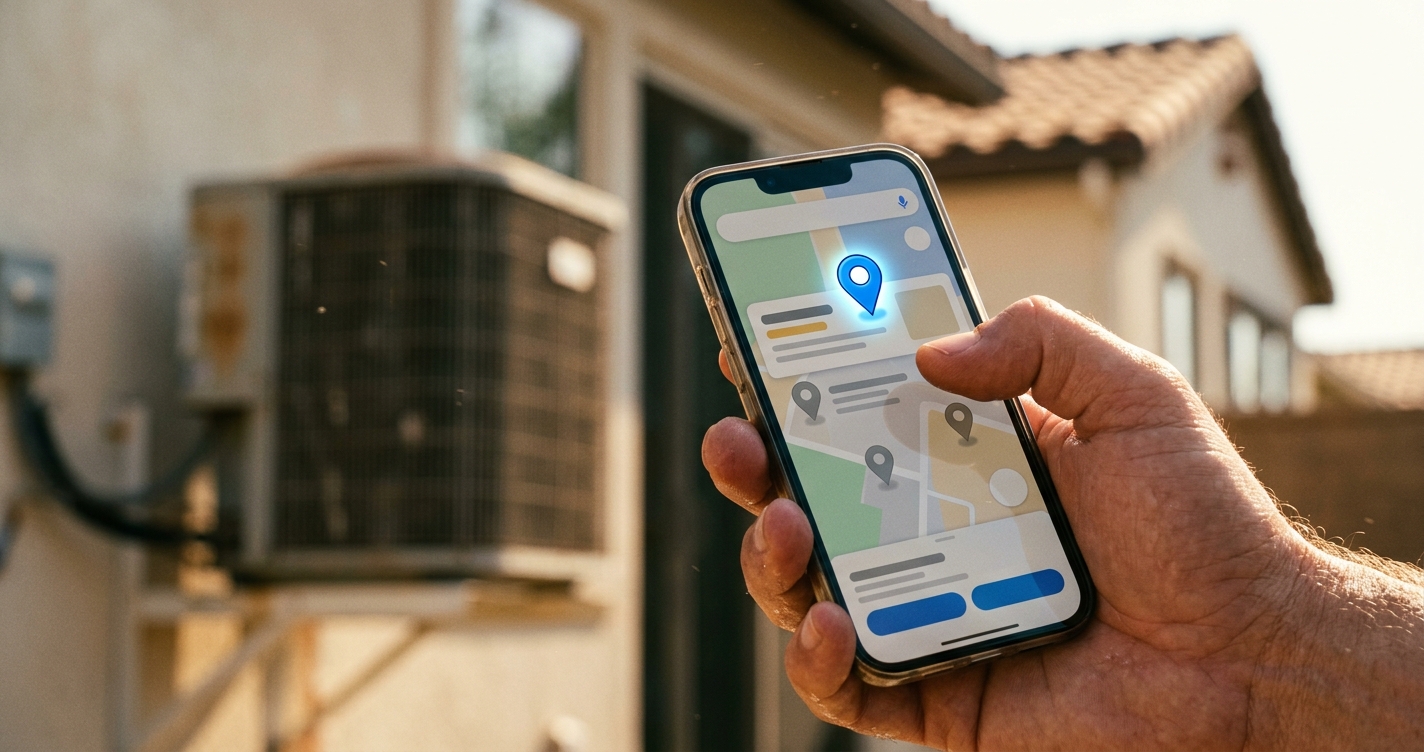
# Local SEO for HVAC Companies: The 2026 Guide to Dominating Local Search
Your HVAC system breaks down at 7 PM on the hottest day of the year. The homeowner doesn't call their second cousin who knows a guy—they search "emergency AC repair near me" on their phone. The HVAC company they find is the one that gets the call. And at $150-$300 per hour emergency rate, that's a call worth fighting for.
HVAC is a seasonal, location-dependent service with extreme urgency spikes. Summer heat waves and winter freezes create search surges where intent is at its highest. Control local search visibility during those windows, and you'll have your phone ringing off the hook and your technicians booked weeks out.
Yet most HVAC companies compete solely on Google Ads, burning cash on expensive clicks. Smart HVAC contractors build local SEO alongside paid advertising, creating a sustainable client acquisition engine that generates quality leads without constantly increasing ad spend.
Our ClawSignal audit data shows HVAC companies that dominate local pack rankings—positions one through three on Google Maps—average 2-3x more qualified job inquiries monthly than those ranked sixth through tenth. And those inquiries convert better because they're from high-intent, urgent searches rather than generic paid ad clicks.
This guide walks you through the exact local SEO system that builds that visibility and wins seasonal search dominance.
The HVAC Search Landscape: Seasonality and Urgency
HVAC search behavior is predictable and extreme. In June, searches for "AC repair San Diego" spike 300%. In January, "furnace repair" and "heater not working" spike similarly. These seasonal surges are exactly when you want maximum visibility.
Google recognizes urgency in HVAC searches. Someone searching "air conditioner repair emergency" has immediate need and high conversion likelihood. Google's algorithms weight these searches heavily and prioritize businesses with strong local signals.
The second advantage: HVAC customers often search at night and on weekends. Someone's AC breaks at 8 PM on a Saturday. They search immediately. You need a mobile-optimized presence and a way to receive emergency requests 24/7, even if your office isn't staffed.
Your competition is hyperlocal. You're competing with three to seven other HVAC contractors in your service area, not with national companies. If your local SEO is stronger than theirs, you win.
Step 1: Dominate Your Google Business Profile
Your Google Business Profile is the HVAC company's primary sales tool. It's the first thing homeowners see, and it directly influences their decision to call you.
Claim your business on google.com/business and verify it. Once verified, complete every field: service areas (list every ZIP code you serve), hours (including emergency hours if applicable), phone number, website, and detailed description.
List all HVAC services you offer: air conditioning repair, air conditioning installation, furnace repair, furnace replacement, heat pump service, HVAC maintenance, ductless mini-split installation, air quality solutions, emergency HVAC service, commercial HVAC, and anything else you provide. Each service is a potential match for customer searches.
Add photos strategically. Upload photos of: - Your service vehicles - Your team/technicians - Before/after shots of installations - HVAC equipment you install - Your office/shop
Update photos monthly. Google's algorithm favors businesses that post frequently—it signals active, current business.
Set your business description to explain your experience, credentials, and service area. Example: "24-hour emergency HVAC repair and installation in San Diego. Locally owned. Family business since 2010. Same-day appointments available." This builds trust and signals availability.
Mark 24-hour availability if you offer emergency service. Create special hours entries for "Emergency Service" that reflect your actual availability (24/7, or specific times). This appears in search results and helps Google understand your service model.
Step 2: Build a Robust Citation Network
Citations establish your HVAC business's local presence and legitimacy. Each citation reinforces your authority to Google.
Claim listings on the major directories: Yelp, Better Business Bureau, Yellowpages, Google Local Services, Home Advisor, Service Magic, Angie's List, and Thumbtack. For HVAC contractors, these are the directories homeowners use when searching for contractors.
Add your business to local San Diego directories: Chamber of Commerce, Better Business Bureau San Diego, San Diego Home Builder's Association (if applicable), and Rotary/Lions clubs if your company is a member.
Use a spreadsheet to track every citation. Document directory, NAP (Name, Address, Phone), username, password, and last update date. Audit quarterly to catch inconsistencies.
NAP consistency is non-negotiable. "San Diego, CA" vs. "San Diego California," "Air Conditioning" vs. "AC," and "Repair" vs. "Repairs"—these inconsistencies confuse Google's algorithms. Your NAP across all citations must be identical.
Step 3: Create Service Area Pages Optimized for Local Search
HVAC customers search geographically: "AC repair in Mira Mesa," "furnace repair near Scripps Ranch," "emergency HVAC La Jolla." Create landing pages targeting these high-intent, location-specific searches.
Build a page for each major service area. If you serve San Diego, Chula Vista, Oceanside, and Escondido, create individual pages for each. Each page should: - Be 800-1,200 words of unique content - Explain why your HVAC company serves that area - Mention neighborhood-specific challenges (coastal salt air affects HVAC equipment differently than inland areas) - Feature customer testimonials from that area - Include a clear call-to-action (appointment booking, free estimate request) - Target local search terms ("AC repair in [neighborhood]")
Write seasonal content tied to HVAC demand. Summer: "Beat the Heat: Summer HVAC Maintenance Checklist." Winter: "Preparing Your Furnace for San Diego Winter." Spring: "Spring HVAC Cleaning and Maintenance Guide."
Create problem-focused content. "Why Your AC Is Leaking," "How to Fix Poor Airflow in Your Home," "What Causes Furnace Failure." These attract searches from homeowners troubleshooting problems, and provide value that builds trust.
Step 4: Leverage Google Local Services Ads
Google Local Services Ads guarantee HVAC companies appear at the very top of search results. For homeowners searching "AC repair near me" or "furnace repair emergency," LSAs appear before organic results and paid ads.
Set up your Google Local Services Ads account. Google requires verification of business license, insurance, and background check for HVAC contractors. Once verified, your ads appear immediately.
LSAs work on a pay-for-lead model—you pay only when a customer contacts you, not per click. This is ideal for HVAC because high-intent searches convert at much higher rates than generic clicks.
Budget $500-$1,500 monthly for LSAs while building organic visibility. As organic rankings improve, reduce LSA spending because organic traffic scales without per-action costs.
Step 5: Optimize Your Website for HVAC Search
Your website is where homeowners verify you're legitimate, understand your services, and decide to call or request an estimate.
Page speed is critical. HVAC customers often search on mobile during emergencies. A slow site loses calls. Google PageSpeed Insights should show a score above 80. If not, optimize images, reduce code, and upgrade hosting.
Make your phone number prominent and clickable on mobile. One-click calling on mobile generates the highest conversion rates for any call-to-action.
Create a clear service menu. Organize by service type: "Repair," "Installation," "Maintenance," "Emergency Service." Each service should link to its own page with detailed information.
Use schema markup (structured data) to help Google understand your business, services, licenses, and location. Schema markup improves your appearance in rich search results.
Include customer testimonials and before/after photos of your work. A photo of a new AC system installation with a customer testimonial is powerful social proof.
Ensure your website clearly displays your HVAC licenses, certifications, insurance information, and awards. Homeowners want to verify you're credible before calling.
Step 6: Generate and Manage Reviews Strategically
Reviews are local SEO signals and trust builders. HVAC businesses with 50+ reviews at 4.5+ stars rank higher and convert better than those with fewer reviews.
After every completed job, request a review. Send an email with a one-click Google review link within 24 hours of completion. Example: "We appreciate your business! Please share your experience on Google to help neighbors find quality HVAC service: [link]."
Respond to every review. For positive reviews, thank the customer, mention specific details (AC unit, location, repair type), and reiterate your commitment. For negative reviews, respond professionally and non-defensively. Offer to discuss offline.
Track review generation. Set a goal: one review per five jobs completed. If you're completing 50 jobs monthly, target ten reviews monthly. Consistency signals active business to Google.
Highlight exceptional reviews on your website and social media. Customer testimonials about your responsiveness and professionalism are powerful marketing assets.
Step 7: Build Local Partnerships and Backlinks
Backlinks from reputable local sources strengthen local authority. Partner with complementary San Diego businesses: home builders, real estate agents, property management companies, and general contractors.
Sponsor local San Diego events, sports teams, or charity fundraisers. Ask organizers to list your company as a sponsor with a link to your website.
Contribute content to local media. San Diego Business Journal, San Diego Union Tribune, neighborhood blogs, and home improvement publications often feature expert advice from contractors. Offer to write an article or be interviewed about HVAC trends, maintenance tips, or energy efficiency.
Join local business networks. Chamber of Commerce, Rotary Club, BNI (Business Network International), and industry associations often feature member websites.
Create shareable HVAC resources. A detailed guide like "Complete Guide to HVAC Maintenance for San Diego Homeowners" (2,000+ words) becomes a resource other websites link to, building your authority.
Step 8: Monitor and Optimize Performance
Use Google Business Profile Insights to track local SEO performance. Monitor search terms people use to find you, which geographic areas generate inquiries, and which actions (calls, estimate requests, website visits) convert most frequently.
Set up Google Analytics with conversion tracking. Tag appointment requests, estimate requests, and phone calls. Attribute revenue to local SEO so you understand actual ROI.
Audit quarterly. Check: - NAP consistency across all directories - Review generation rates and ratings - Keyword rankings for primary HVAC search terms - Competitor visibility and positioning - Website traffic and conversion rates
Make improvements based on audit findings. If competitors outrank you for "furnace repair San Diego," create more location-specific content and build more local backlinks.
FAQ: Local SEO for HVAC Companies
Q: How quickly will I see results from HVAC local SEO? A: Google Business Profile optimization can show results within 2-4 weeks. Meaningful ranking improvements typically take 4-8 weeks. Major authority building takes 3-6 months. Seasonal spikes (summer/winter) amplify results during peak HVAC demand periods.
Q: Should I use Google Ads or focus on local SEO? A: Use both. Google Ads (including Local Services Ads) drive immediate, high-intent traffic. Local SEO builds sustainable traffic that scales without increasing ad spend. Run both during HVAC demand spikes, then rely more on organic during slower seasons.
Q: My HVAC company serves 12 different towns. Do I need separate pages for each? A: Yes, create individual pages for your top 5-8 service areas. Focus on areas where you have the most jobs completed and best customer concentration. Depth in fewer areas beats thin coverage of many areas.
Q: What's the best way to collect HVAC reviews? A: Email customers a Google review link within 24 hours of job completion, when their experience is fresh and positive emotions are highest. Make it one-click. Offer a small incentive (10% discount on next service) to encourage reviews without violating Google's policies.
Q: Should I focus on emergency HVAC or maintenance services for local SEO? A: Target both. Emergency searches (high-intent, urgent) convert at higher rates but are seasonal. Maintenance searches are steady year-round. Create content for both to capture seasonal spikes and build baseline traffic.
Q: What's the ROI on local SEO for HVAC? A: HVAC businesses typically spend $1,000-$2,500 monthly for professional local SEO management. If you complete 40 jobs monthly and 25% come from local search (10 jobs), and average job value is $500-$1,500, monthly revenue from local SEO is $5,000-$15,000. ROI is typically positive in month one and increases over time. See clawsignal.co/services for customized pricing.
Sources
- Google Business Profile Insights analysis (ClawSignal audit data, 2025-2026)
- Search Engine Journal: Local SEO for HVAC contractors
- MOZ: Local Search Ranking Factors (2025)
- Google Search Central: Guidelines for service-based businesses
- HVAC industry data: Seasonal search trends
- BrightLocal: Contractor local SEO benchmarks
Ready to Dominate HVAC Search in Your Area?
Stop watching calls go to competitors. Get a free local SEO audit for your HVAC company to identify ranking gaps, then explore our full HVAC SEO services to accelerate your growth during peak seasons and year-round.