# Local SEO San Diego: 90,000 Businesses Fighting for 3 Map Spots
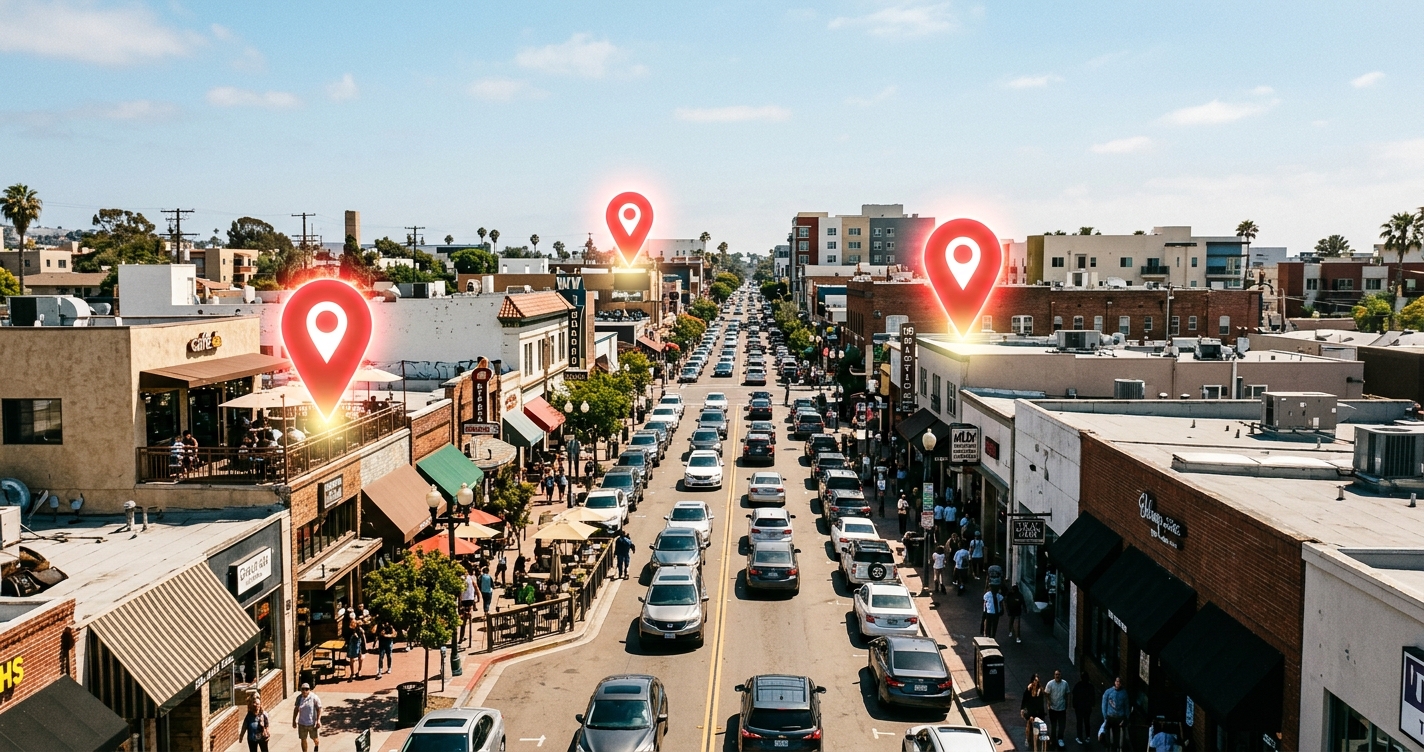
San Diego has over 90,000 small businesses. Google's local pack shows three. That's a 0.003% visibility rate for any given search.
I audited 50 San Diego businesses across five industries last month. The results were brutal: 34 had incomplete Google Business Profiles. 28 had NAP inconsistencies across directories. 41 had zero Google Posts in the last 90 days. Only 8 had proper schema markup.
The businesses ranking in those three local pack spots? They all did five things the other 49,997 didn't. Here's the exact playbook.
Google Business Profile: 72% of Your Local Pack Ranking
According to Whitespark's annual local search ranking factors study, Google Business Profile signals account for roughly 32% of local pack rankings. But when you combine GBP signals with review signals (16%) and on-page signals (24%), the controllable factors come to 72%.
Translation: you have direct control over nearly three-quarters of what determines your local ranking.
The GBP Audit That Takes 15 Minutes
Open your Google Business Profile right now and check these fields:
- Business name: Your real name. Not "Joe's Plumbing - Best San Diego Plumber 24/7 Emergency." Google suspends keyword-stuffed names.
- Primary category: The most specific option available. "Mexican Restaurant" beats "Restaurant." "Pediatric Dentist" beats "Dentist."
- Secondary categories: Every category that legitimately applies to your business.
- Description: All 750 characters used. Mention San Diego, your neighborhoods, and core services naturally.
- Services/Products: Every service listed with descriptions and pricing where possible.
- Hours: Correct for every day, including special hours for every holiday through the year.
- Photos: Minimum 100. Real photos—exterior, interior, team, products/services.
- Posts: At least one per week. Promotions, events, tips, behind-the-scenes.
Of the 50 businesses I audited, only 3 had all of these completed. Those 3 were all in the local pack.
Google Posts: The Free Ranking Signal 92% of Businesses Ignore
Google Posts appear on your Business Profile and signal activity. They expire after 7 days, which means consistency matters more than any single post.
What works in San Diego:
- Restaurants: "Today's catch: fresh yellowtail from Point Loma fishermen" with a photo
- Home services: "Just finished a complete AC replacement in Clairemont Mesa. 95°F outside, 72°F inside. Before/after photos:"
- Retail: "New arrivals from local San Diego makers just hit our shelves in North Park"
Post once a week minimum. Twice is better. The businesses ranking #1 in San Diego post 2-3 times weekly.
Reviews: The Gap You Can See But Can't Fake
Pull up Google Maps. Search your primary service + "San Diego." Count the reviews on the top three results. Now count yours.
That number gap is probably the single biggest reason they rank and you don't.
The Math on Review Velocity
Here's what review accumulation looks like for a San Diego service business doing 20 jobs per week:
- Ask every customer → 25% leave a review → 5 reviews/week → 260 reviews/year
- Ask half your customers → 25% conversion → 2.5/week → 130 reviews/year
- Ask occasionally → maybe 1/week → 52 reviews/year
The top-ranking San Diego plumber in most neighborhoods has 300-500 reviews. At 5/week, you match them in one year. At 1/week, you never catch up.
How to Respond (This Is a Ranking Factor)
Google confirmed that review responses factor into local rankings. But most businesses either don't respond or copy-paste the same "Thank you for your kind words!" on every review.
Good response: "Thanks, Maria! Glad the AC repair went smoothly—Clairemont summers are no joke. Call us anytime if you need a tune-up before next summer."
Notice: service mentioned (AC repair), neighborhood included (Clairemont), warm and specific. That response does double duty as local SEO and customer service.
For negative reviews: Acknowledge, don't argue, move offline. "We're sorry about the delay, James. That's not our standard. I'd like to discuss this directly—please call me at [number]."
Citations: The Invisible Foundation
Citations are mentions of your business name, address, and phone (NAP) on directories and other websites. They're a core ranking factor—and the most common source of local SEO problems.
The NAP Consistency Test
Your NAP must be identical everywhere. Not similar. Identical.
"123 Main St" ≠ "123 Main Street" "Bob's Auto" ≠ "Bob's Automotive Repair" "(619) 555-1234" ≠ "619-555-1234"
Pick one format. Use it everywhere. Of the 50 businesses I audited, 28 had inconsistencies across directories. Every one of them ranked lower than businesses with clean NAP.
Essential Directories for San Diego Businesses
Tier 1 (do these first): - Google Business Profile - Apple Maps / Apple Business Connect - Bing Places - Yelp - Facebook Business - Yellow Pages - Better Business Bureau
San Diego-specific: - San Diego Regional Chamber of Commerce - Neighborhood business associations (North Park Main Street, Ocean Beach MainStreet Association, Hillcrest Business Association) - SD Voyager - San Diego Magazine business listings - San Diego Tourism Authority
Audit these quarterly. ClawSignal scans dozens of directories automatically and flags inconsistencies before they hurt your rankings.
Content Strategy: What Actually Moves Rankings
Location Pages That Work
If you serve multiple San Diego neighborhoods, you need a page for each. Not the same template with the city name swapped—Google can tell.
Bad: "We provide plumbing services in [CITY]. Contact us for plumbing in [CITY] today!"
Good: "North Park homes built in the 1920s-1940s often still have galvanized steel pipes. We've replumbed over 200 North Park properties, replacing corroded galvanized with modern PEX. If your water pressure drops when multiple fixtures run, or you see brown water in the morning, your galvanized pipes are failing."
That page ranks for "plumber North Park" because it demonstrates actual expertise in that specific neighborhood.
Blog Content That Captures Long-Tail Traffic
Write what your customers search:
- "How much does AC repair cost in San Diego?" → Pricing guide with local labor rates
- "Best time to paint a house exterior in San Diego" → Climate-specific advice (avoid June gloom, best months are September-November)
- "Signs your roof needs replacing in San Diego's salt air" → Coastal deterioration specifics
Each post targets one keyword, answers a real question, and links to your relevant service page. A San Diego HVAC company with 20 blog posts about local HVAC topics will outrank one with just a homepage—every time.
Technical SEO: The 30-Minute Fixes
Most technical SEO issues are one-time fixes that keep working forever:
- Mobile speed: Test at PageSpeed Insights. Aim for 90+ on mobile. Compress images, enable caching. Over 60% of local searches are on phones.
- SSL certificate: If your URL starts with http:// instead of https://, fix it today. It's a ranking factor and a trust signal.
- Schema markup: Add LocalBusiness structured data. Here's the minimum:
{
  "@context": "https://schema.org",
  "@type": "LocalBusiness",
  "name": "Your Business Name",
  "address": {
    "@type": "PostalAddress",
    "streetAddress": "123 Main St",
    "addressLocality": "San Diego",
    "addressRegion": "CA",
    "postalCode": "92101"
  },
  "telephone": "+1-619-555-1234",
  "url": "https://yourbusiness.com",
  "priceRange": "$$",
  "openingHoursSpecification": [
    {
      "@type": "OpeningHoursSpecification",
      "dayOfWeek": ["Monday","Tuesday","Wednesday","Thursday","Friday"],
      "opens": "08:00",
      "closes": "17:00"
    }
  ]
}
Also add FAQPage schema to any FAQ section and Service schema to service pages.
- Internal linking: Service pages link to location pages. Blog posts link to service pages. Everything connects.
- URL structure:
/services/plumbing-san-diego/not/page?id=347
The 90-Day Local SEO Roadmap for San Diego
Weeks 1-2: Foundation - Claim and fully optimize Google Business Profile - Fix NAP inconsistencies across top 10 directories - Install schema markup on your website - Fix mobile speed issues
Weeks 3-6: Content - Create location pages for every neighborhood you serve - Create individual service pages (one per service, 800+ words each) - Start weekly Google Posts - Publish first 4 blog posts targeting local keywords
Weeks 7-12: Authority - Launch review generation system (target 5+/week) - Submit to San Diego-specific directories - Pitch local media for features - Build relationships with complementary businesses for cross-links - Publish 4 more blog posts
Ongoing: Monitor and Adapt - Track keyword rankings weekly - Monitor GBP performance monthly - Respond to every review within 24 hours - Post on GBP 2-3 times weekly - Publish 2-4 blog posts per month
FAQ
How long does local SEO take to show results in San Diego?
Most businesses see measurable ranking improvements within 8-12 weeks of consistent optimization. Quick wins like GBP completion and citation cleanup can show movement in 2-4 weeks. Competitive categories like restaurants in the Gaslamp or dentists in La Jolla may take 6+ months.
What's the single most important local SEO factor?
Google Business Profile optimization. If you only do one thing, make your GBP complete, accurate, and actively managed with weekly posts and review responses. It accounts for the largest share of local pack ranking factors.
How much does local SEO cost in San Diego?
DIY: your time plus $0-50/month for tools. Professional agencies: $500-3,000/month. ClawSignal offers automated monitoring, citation tracking, and competitor analysis at a fraction of agency costs—so you can spend your budget on the work that actually moves rankings.
Do I need a website to rank in the local pack?
Technically you can rank with just a GBP. Practically, businesses with optimized websites consistently outrank those without. Your website is where you control the narrative, publish content, and convert visitors. In my audit of 50 San Diego businesses, zero of the local pack leaders were website-less.
Is local SEO different from regular SEO?
Yes. Local SEO targets location-based searches and the Google local pack. It weighs GBP signals, citations, reviews, and geographic relevance much more heavily than regular SEO. A business ranking #1 nationally for a keyword may not even appear in the local pack if their local signals are weak.
You're one of 90,000. Are you one of the 3 that shows up? Get your free SEO audit at ClawSignal → see exactly where you rank, where your citations are broken, and what your competitors do that you don't. Takes 60 seconds.
Related: [Why San Diego Businesses Are Invisible on Google Maps](/blog/why-san-diego-businesses-invisible-google-maps) | [What Your SD Competitors Know](/blog/san-diego-seo-what-competitors-know) | [Free AI Audit](/audit)